The corridor is
already built.
The full read on Corridor — what it is, why it exists in this shape, and what changes when a state turns one on.
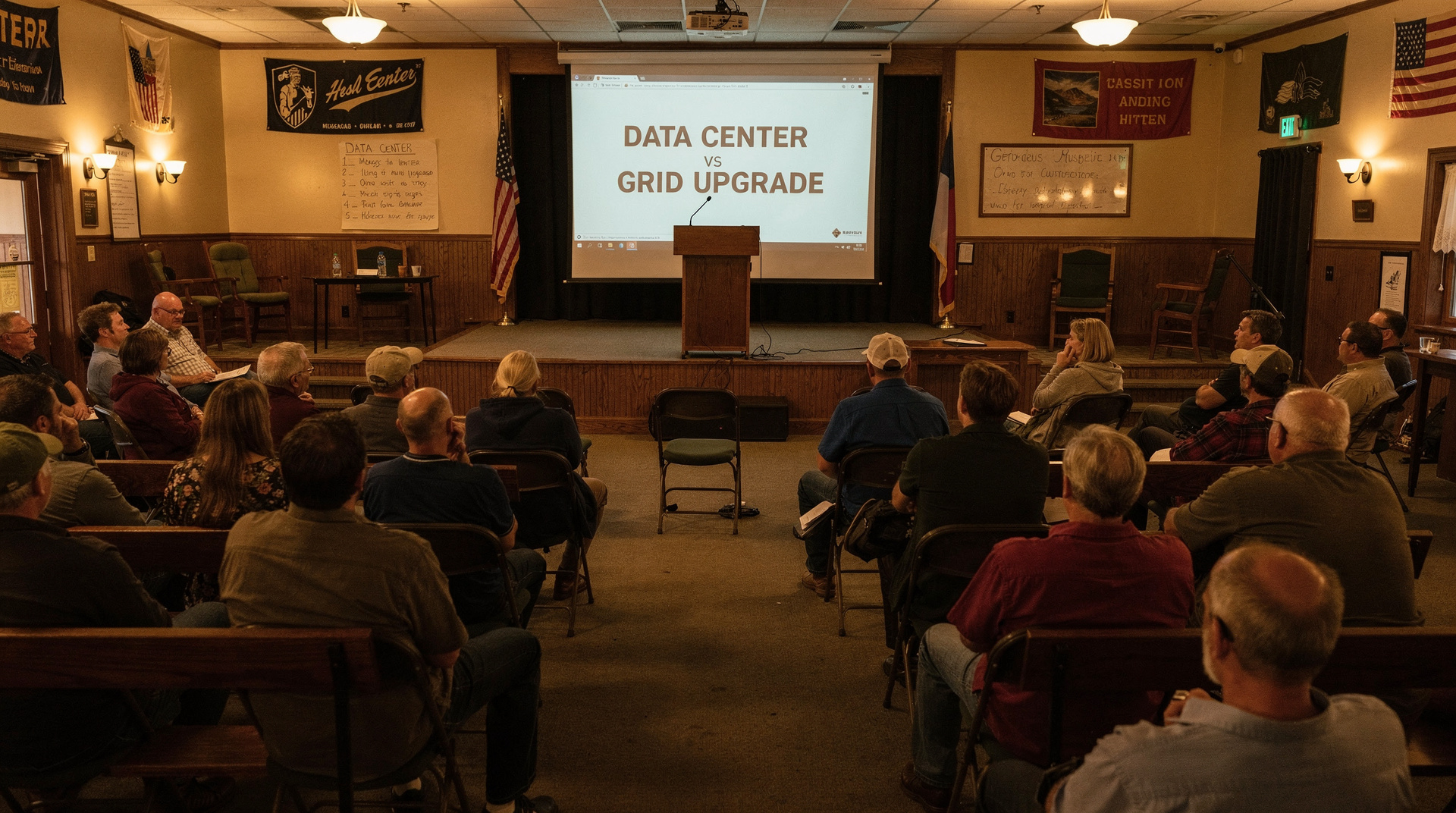
Or watch the 90-second version →A choice that shouldn't have to be a choice.
More compute or a working grid. New broadband or the existing transportation budget. AI infrastructure or rural water. Every framing forces a tradeoff. Every tradeoff ends with someone losing.
Communities are not rejecting the future. They are rejecting the shape it has been offered to them in.
One device. Three outcomes.
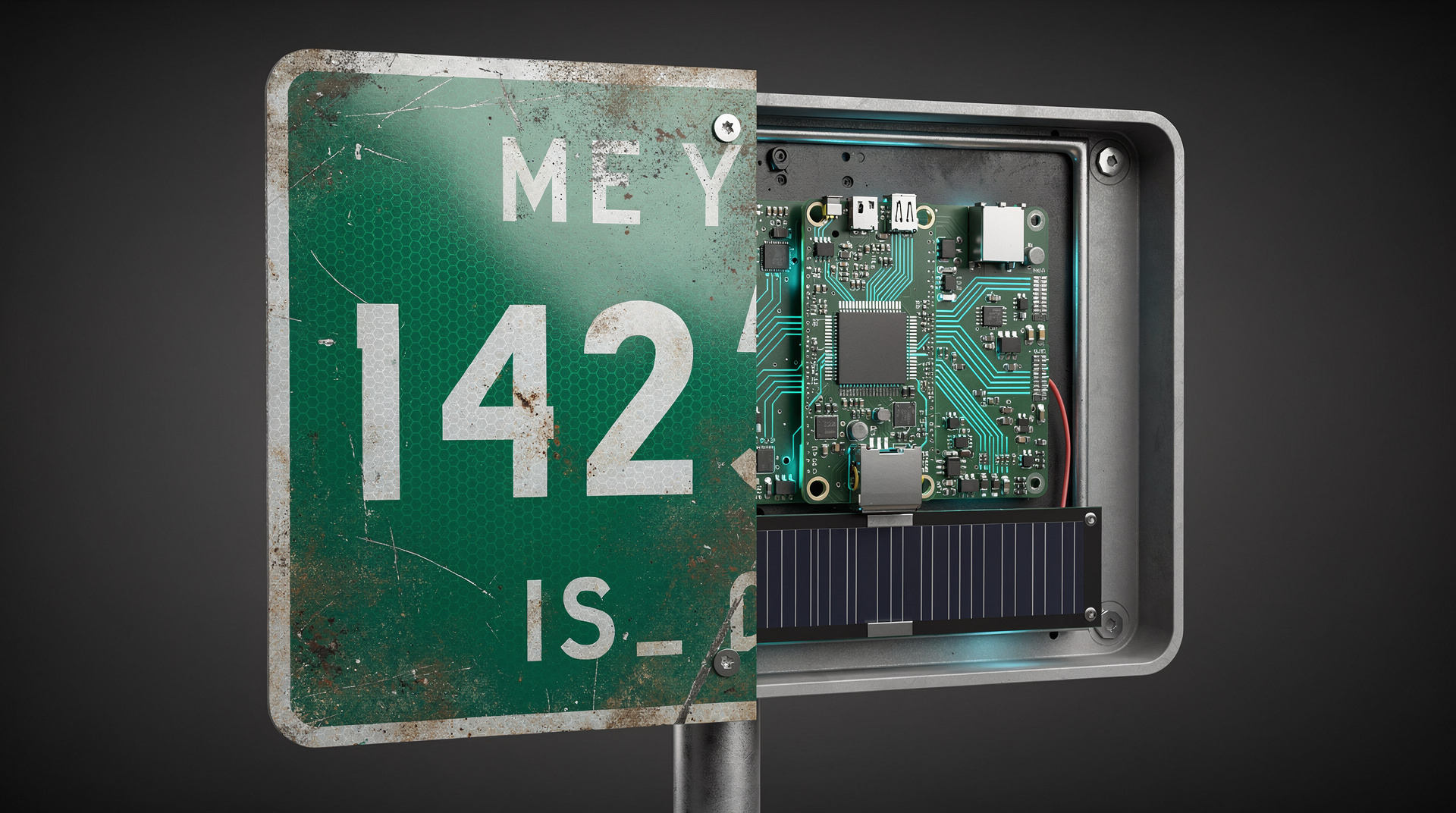
Corridor is one integrated unit — not three products bolted together. It harvests its own energy, runs compute on what it harvests, and forms a mesh with its neighbors.
Five ambient energy sources are available to the unit at any given moment: light, heat, radio, vibration, and humidity. The last one matters because it penetrates enclosures — the unit can charge from day–night humidity gradients alone, even sealed inside a reflector or a bulb housing.
Energy, compute, and communications all come out of the same install. One purchase order. One install schedule. One thing to maintain.
On the infrastructure that's already there.
Corridor units bolt onto infrastructure the public already owns. Mile markers, light poles, signs, guardrails. The pole is already in the ground. The right-of-way is already secured. The maintenance crew is already on the schedule.
One module, three mounting form factors. Same hardware, both rural corridors and dense urban grids. The unit senses what kind of environment it lands in and configures itself.


Same crews. Same trucks.
Same budget.
Corridor is not a new program asking for new money. It is a SKU change on a maintenance cycle that is already funded, already scheduled, and already in the field.
The capabilities of a Corridor install map cleanly to existing federal funding categories. Federal participation arrives through programs the state is already eligible for.
One field deployment of the fabric.
Corridor is the ThermoEdge Compute Fabric in the field. The fabric removes the energy bill; the chip carries it; the architecture lets it ship as one module. The corridor is where all three meet a road.
Five substrates. One bill removed.
Each operation runs on the substrate whose physics performs it natively. The energy budget collapses before the harvest has to cover it.
One die. Four form factors.
TESilicon — a heterogeneous system on module with on-die energy harvesting. The chip at the heart of every Corridor unit.
One design, not three products.
Unified Design Architecture is why energy, compute, and comms come out of a single install — they came out of a single design.
What the install commits to.
Corridor is the ThermoEdge fabric in the field — and ThermoEdge is a subsidiary of Open Interface Engineering. Three commitments come through to every unit on every pole.
01 · The unit
Priced in joules.
The install meters the energy it draws and the energy it delivers. The state pays the second law, plus operations — not an opaque markup.
02 · The lifetime
Make once, use forever.
The unit ships with the artifact's lifetime as the unit of sale. No refresh cycle. Maintained on the cycle the state already runs.
03 · The loop
Return the substrate.
At end of life the unit comes back. The substrate is re-made. The corridor is not a disposable rollout — it's a closed loop the state participates in.